back
First Acoustic Images
over far Distances,
First Acoustic Movies
We hung a 16-channel microphone array in strings out of the windows at the 8th floor of Building 13.7 (today Albert-Einstein-Str.16, 12489 Berlin-Adlershof, Germany), trying to make first records over far distances. Here are the results.
Arangement
The measurement was a first attempt to prove the mask algorithm of Heinz Interference Transformation (HIT) over very far distances and to test the usability for acoustic movies. In the approach, a neural field is simulated by image pixels. It gets 16 different input data streams (microphone channels). Time flows backward through computer simulation (better: we compensate the delays). So we get a (non-mirrored, non-distorted) reconstruction instead of a mirrored, distorted (optical) projection.
The task is, to detect sources of excitement only by inspecting the channel data. We worked with 16 microphones hanging out of the window (left picture) in the 8th floor (Gefell MK250, 1/2", 50mV/Pa, 5x6 meter- array). The right picture shows the view out of this window.
For analog to digital conversion we used a self-made soft-controlled preamplifier with aliasing filters in hardware and a WIN30DS-ADC- card (National Instruments) with 1MS sum rate, 16 channels. So the maximum sampling rate per channel was 50 kS/s.
Behind cars on the street in the foreground we could detect different cars on the street far in the background.
a) 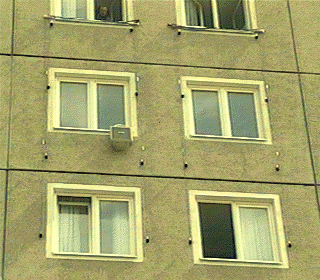
b) 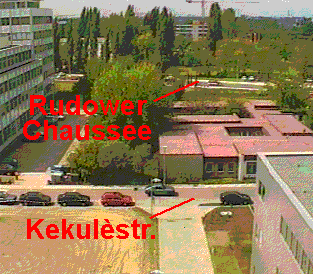
c) 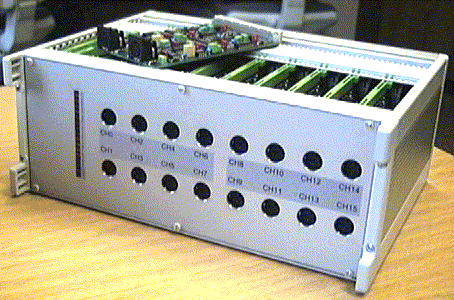
d) 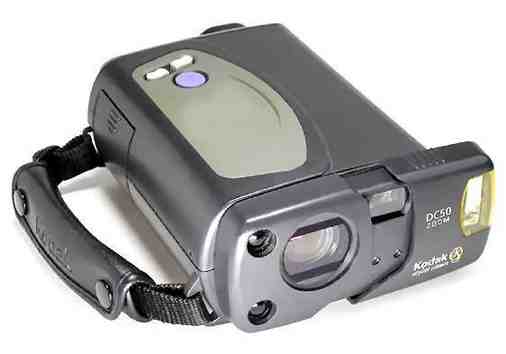
Fig.1a) 4x4 Microphone arrangement at the wall of Building 13.7
Fig.1b) Viewing direction to the city of Berlin (north);
Fig.1c) Soft-controlled 16-chnl. preamplifier;
Fig.1d) The photos were made with our first digital camera Kodak DC50 ZOOM.
To get a minimum wavelenght for the refexion at the wall, the microphones were placed nearest to the wall. A pop-filter was used to avoid wind noise. So the effective distance s to the wall was approx. 3 cm, the according lenght of reflexion is 6 cm and the highest measurable frequency was therefore
f = v/s = 340 m/s / 6 cm < 5.6 kHz.
First Acoustic Outdoor Images over 70 and 170 Meter
Records from August 8, 1996, Carsten Busch & Gerd Heinz
c) 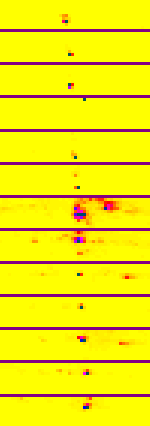 d)
d) 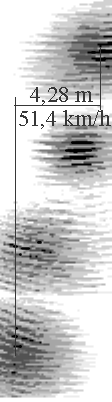 e)
e) 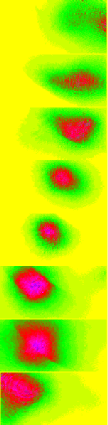
Fig.2c) shows a Ford Fiesta crossing from left to right the Kekulestr. in a distance of 70 meter. Interference integrals done with 1000 samples each/10kHz. The reflexions behind the car ar very intensive. Thus the excitement appears on a higher position, when passing the house right in the foreground. Picture dimension: 50x10 meters, multiplication of masks, focus 70 meter. Data: 0808_21.chl, Abtastrate 10 kHz, Hardware-Filter 0.5dB: HP: 300Hz/300Hz, TP: 1000/1000Hz. Click the image to hear it.
Fig.2d) shows a bus crossing the Rudower Chaussee in a distance of 170m. We calculated the speed. Four interference integrals are taken with 1000 samples each/10kHz subsequent with 1/10 second, the picture dimension is 6x5 meters each. We find the bus a little to fast, allowed are 50km/h. Please note a interferencial sampling theorem. As more far we calculate the reconstructions, as smaller is the viewing angle in degree, as more the channel data sampling comes in sight as a light wave pattern. Data: channel data 0808_31.chl, Abtastrate 10 kHz, Hardware-Filter 0.5dB: HP: 3000Hz/3000Hz, TP: 1000/1000Hz. Click the image to hear it.
Fig.2e) shows a car at the Rudower Chaussee, crossing from right to left in a distance of 170 Meter. (It shows two pasted parts of the following discussed 'wind'-sequence). Window size: 14x7m; microphone array 6x5m; 16 channels; 0808_32.chl; calculation: 29.8.1996. Click the image, to here the channel data sound (chl 0); Abtastrate 10 kHz, Hardware-Filter 0.5dB: HP: 3000Hz/3000Hz, TP: 1000/1000Hz.
Here the sound clicking the images.
By the way: Pohlmann [1] showed in 1939 first ultrasonic, acoustic images with acoustic lenses. Echo-based ultrasonic methods find wide applications in medicine. From dolphines and bats we know phantastic, ultrasonic echoic localization techniques.
First Acoustic Movie over far Distance: 170 Meter
Find here first acoustical far-field movies in the farest distance, that until now has been produced. It is developed automatically by PSI-Tools in a Distance of 170 Meter (thanks to Mr. Tan Nguyen for the fast PSI-implementation). The results surprise.
[Remark 2020:] See also later comparable investigations [4] with 29 microphones in a distance of 36 meter, done with traditional techniques.

Fig.3: The movie shows a bus, crossing the Rudower Chaussee from right to left in a distance of 170 meter. Click the image, to get the historic original AVI-file.
Data: picture frequency 40 Hz, integration interval for each image 0.15 sec; window BxH = 35x10m; distance 170m; microphon array BxH 5x6m; speed of the bus is calculated to 46,6 km/h over the window size, algorithm 'effective value', channel data 0808_31.chl, bus_31.ini, automatic colour contrast adaption; 8.8.1996. Comparable with Fig.d). Against the last 5 meters the bus moves behind the IGZ-Building lefthand. The automatic colour contrast adaption was on. So it covers this amplitude reduction.
Influence of Air Movement over 170 Meter
We find the car not always going straight forward. Partially we found it going back reasoned by wind direction and turbulence. Window size: 14x7m, microphone array 6x5m, 16 channels.
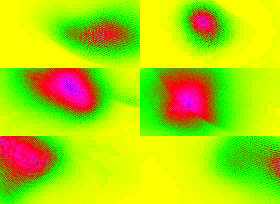
Fig.4: The movie shows the car at the Rudower Chaussee, crossing from right to left under strong wind influence. The excitement locations move around. Click the image, to get the historic original AVI-file. Subsequent short-time integrals (25ms) of the car in 170 meter distance under influence of wind
Data: Experiments at August 29, 1996, 10pm, air velocity 341,4m/s, distance 170m, Ini-File 3c_03k.ini, channel data 2908_3c.chl, bitmaps 3c_03k.bmp ... 3c_18k.bmp, sample rate 20kS/s, integration time 500 Sampels or 25ms, time distance between subsequent images 50ms, hardware-filter 0.5dB, highpass 1/2: 3000Hz/3000Hz, lowpass 1/2: 5000Hz/5000Hz, software filter off.
Berlin at Night at
Inversion Weather Conditions
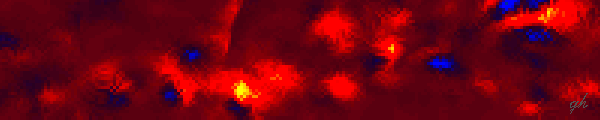
Fig.5: First acoustic photo with noise reflected at clouds over the Berlin city. At inversion wheater conditions, the ground is colder than the clouds, the warmer clouds diffract the noise back to the ground, so one can hear over very large distances. The recording distance was more then approx. 10 kilometers with the microphone array hanging at Building 13.7, 8th floor. See the array in Fig.1a), and the view direction in Fig.1b). Colors: Yellow for strong activity; blue for week activity (inverse colour table). The bigest yellow dot pointed accidental in direction to the Alexanderplatz.
Acoustic photo over the nightly summer ground noise comming from the city of Berlin at 10 pm. The virtual view is directed with an altitude angle of approx. 15 degree into the northern sky (city of Berlin in 10 km). The time functions seem to contain nothing then noise. In the interference integrals we find different noise reflections or diffractions [2] of the city. Different acoustic "blow outs" and thermic reflections at cloudes appear and disappear suddenly.
Data: 16-channel reconstructive interference integral; PSI-Tools Virtual Screen: 200m x 40m, virtual focus at 170 meter. The lower border of the image was set on the horizont line. Location Rudower Chaussee 5, Geb. 13.7 (now: Albert-Einstein-Str. 16), 8th floor in northern direction (NNW) see Fig.1. Microphone-array 16 chls., 6x5m. Algorithm: multiplication of monopolarized time functions. Recorded at 8.8.1996, 10pm. Channel data 0808_27.chl, 10 kS/s, interval 7000...8000, 1/10 sec., longer integrals become softer.
References
[1] Pohlmann, R.: Über ein mit einem akustischen Hohlspiegel arbeitendes Abbildungsverfahren, bei dem das entworfene Bild mittels eines Empfängers zeilenweise abgetastet wird. Zeitschr. Physik 113, 697 (1939); Forsch. Fortschr. 16, 248 (1940); Z. angew. Physik 1, 181 (1948); Die Technik 3, 465 (1948). Zitiert aus Trendelenburg: Akustik. Springer Heidelberg, Zweite Auflage 1950, S.207
[2] Ferdinand Trendelenburg: Akustik. Springer Heidelberg, Zweite Auflage 1950, S.200 ff. Blow out: Je nach Stärke eines Windgradienten erfolgt eine Abbiegung des nach oben aufsteigenden Schalls in Windrichtung nach unten. Derselbe Effekt kann bei thermisch induzierten Geschwindigkeitsgradienten beobachtet werden.
[3] Buckingham, M.J., Potter, J.R. Epifanio, Ch. L.: Seeing Underwater with Background Noise. Scientific American, Febr. 1996, pp. 40-44
[4] Michel, U., Barsikow, B., Haverich, B., Schüttpelz, M.: Investigation of airframe and jet noise in high-speed flight with a microphone array. 3rd AIAA/CEAS Aeroacoustics Conference 12-14 May 1997, Atlanta, AIAA-97-1596
G. Heinz
Mail to: info@gheinz.de
File created Aug.19, 1996
HTML-redesign Oct. 2020
Layout enabled for smartphones Nov.14, 2023 and Dec. 2025
back